
Available
Only three copies of The Sinking of the Titanic are available, each in a unique fine binding. Unbound copies or custom bindings are available upon request.


Copy 22/30
$ 16,500
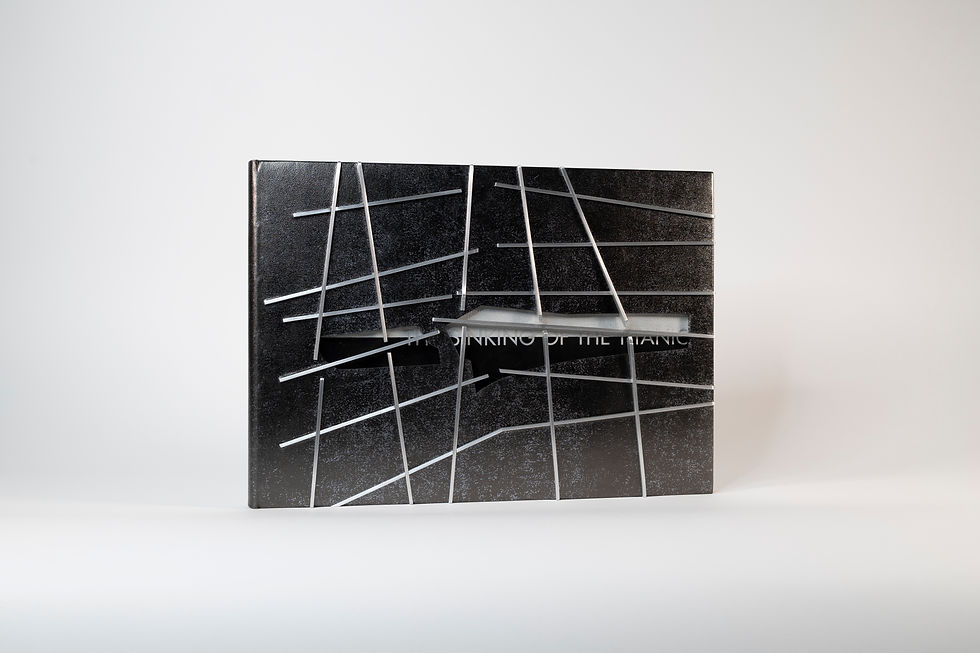

Copy 24/30
$ 16,500

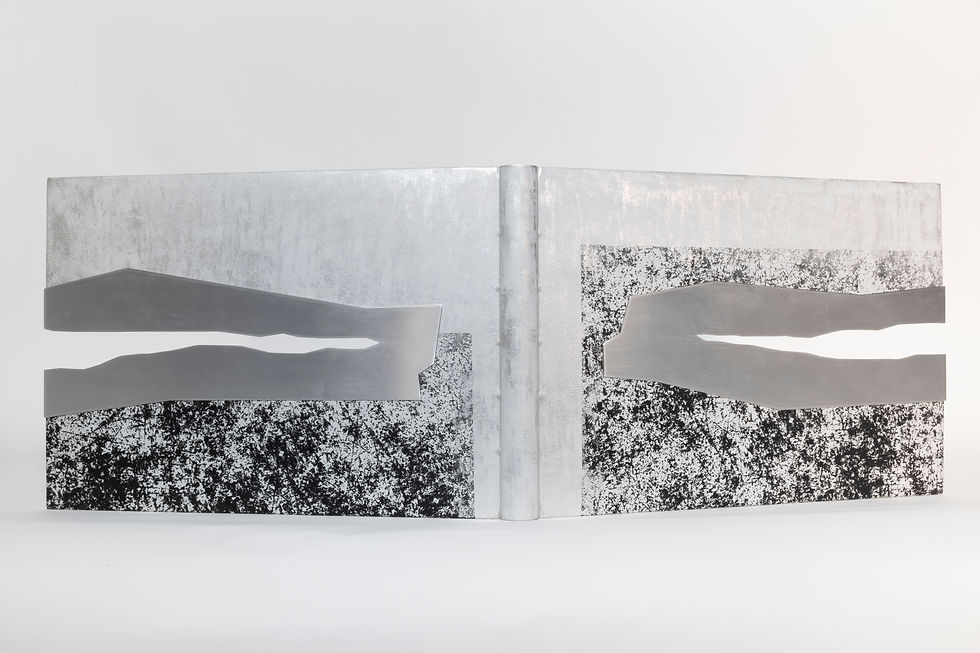
Copy 23/30
$ 16,500


Copy 25/30
$ 16,500
Note: Each of these three bound copies is part of the head edition. Each copy contains six etchings signed and numbered by Cristina Iglesias: three are included as illustrations within the book, and three are placed at the end of the volume, designed to be removed and enjoyed as independent works of art.
For reservations, offers, or requests to purchase the entire series, please contact us.



The Sinking of the Titanic
Made in Rimini, Italy, in 2023 by Luigi Castiglioni
Text & Music: Gavin Bryars’ The Sinking of the Titanic
3 Illustrations by Cristina Iglesias
The Last Note: Art at the Edge of Death
The story of The Sinking of the Titanic began in 1968, when composer Gavin Bryars, then a part-time lecturer at the University of Portsmouth, participated in a conceptual art exhibition. His contribution was modest in appearance—a single A4 sheet of text—but rich in resonance. It spoke of the ship’s orchestra, which, according to survivors, had continued to play as the Titanic slipped beneath the waves. He reflected on the acoustic phenomena this surreal image evoked—the reverberations of sound beneath water, the distortion of music swallowed by the sea. The text was not a musical score but an invitation to imagine one. It caught the attention of Victor Schonfield, director of Music Now, who, years later, encouraged Bryars to give this vision sonic form. Between 1969 and 1972, Bryars immersed himself in survivor accounts, ship schematics, and historical records, assembling not a conventional composition, but a kind of acoustic palimpsest. He drew upon hymns said to have been played by the orchestra—Autumn, Aughton—and recombined them with imagined textures, echoes, and absences. The piece became an assemblage, less about melody than about atmosphere—a meditation on the physical space of sound, on what music might become as it lingers, collapses, and dissolves beneath the surface of the sea. Working with the Physics Department at Cardiff University, Bryars even explored how underwater acoustics might translate into sound art. In 2023, Luigi Castiglioni sought to tell this same story with the materials closest to his creative voice: typography, colors, and textures. In his artist’s book, he wove together fragments of sound and memory with visual and tactile elements to evoke the ship’s final moments, giving physical form to Gavin Bryars’ music. "In this artist’s book, I wanted to tell this story with the means that I felt are most akin to my creativity: typographic materials, colours and textures. With Gavin Bryars, I wanted to collect each fragment of original sound to make them a piece of a new creation: the memories of the survivors, the three strikes of the ship’s bell, the music that accompanied the collision and the sinking. Along with the black and silver of the scores, I wanted to insert a series of graphic and coloristic interventions that created the experience of the collision of steel against ice, of night on the ocean and of souls and bodies slowly sinking. A desperate SOS closes the score. It is an echo capable of sounding alive and heartbreaking till today. The collaboration with artist Cristina Iglesias, very much attentive to the interaction between mankind and nature, has allowed me to emphasize the visual suggestion with prints of great emotional power." This compelling work is the most intricate artist’s book Castiglioni has created to date—a dense concentration of sound, image, voices, and color. It sublimates the sonic memory of a catastrophe into an astonishing, transcendent work of art. Together, Bryars and Castiglioni offer not a reconstruction of the Titanic’s sinking, but a poetic reimagining—a shared meditation on fragility, reverberation, and the enduring resonance of human gesture in the face of silence.
Description
-
Printing Technique: Letterpress printing
-
Paper: Fabriano Tiepolo 250 gsm
-
Printing Press: Original Nebiolo Atena cylinder press (1963)
-
Printing Studio: Tipoteca Italiana Cornuda (Treviso)
-
Etchings: Processed on polymer plates
-
Etching Print Studio: Benveniste Contemporary, Madrid
-
Edition: Limited to 130 copies, signed by Gavin Bryars and Cristina Iglesias
-
No. 3 Illustrations (Etchings) by Cristina Iglesias, each numbered and signed.
-
Numbering & Composition:
-
Arabic numerals (1/100 to 30/100): Includes three etchings, one suite of etchings, and an engraved metal printing plate
-
Roman numerals (I/XXX to XXX/XXX): Reserved for collaborators and artists
-
-
Each copy includes: Gavin Bryars’ autograph musical notation representing the sound of the Titanic’s bell (E flat) a 10 inch vinyl record with on side A the original sounds used by Gavin Bryars to compose the pre-recorded material for performing the piece and on side B the testimony of Miss Edith Russell and Miss Eva Hart two survivors of the tragedy interviewed by Gavin Bryars in 1972.
Special thanks to Schott Music Ltd
For the original music score: ©1994 Schott Music Ltd
Reproduced by permission. All rights reserved
For this printed edition: ©2023 Luigi Castiglioni Editore Rimini
Reproduction not permitted


